Control Algorithms & Diagnostics
Predictive In-Cycle Combustion Control
Adjusting fuel injection before the combustion cycle is over
How predictive closed-loop controllers use pressure feedback, virtual sensing, online model adaptation, and FPGA implementation to regulate combustion within the same engine cycle.
Key ideas
- In-cycle combustion control acts before the current cycle is complete.
- Predictive models overcome the delay between fuel injection and measured combustion output.
- Virtual sensors provide early combustion-state estimates from pressure data.
- Online adaptation improves robustness when operating conditions or fuel properties change.
- FPGA implementation makes crank-angle-resolved control feasible in real time.
Most combustion controllers operate from one engine cycle to the next. They measure what happened in a completed cycle, compare it with a target, and then adjust the next cycle. That approach is practical and widely used, but it has a fundamental limitation: it can only correct combustion after the event has already happened.
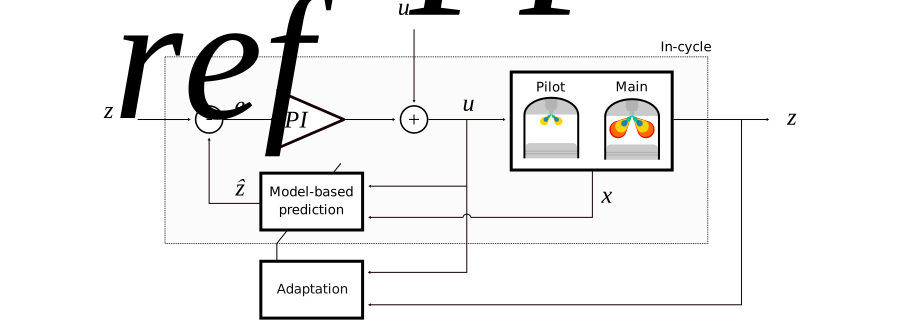
In-cycle combustion control asks for something faster. It uses measurements from the current combustion event to adjust a remaining actuator action within that same cycle. In pilot-main diesel combustion, this means observing the pilot combustion early enough to modify the following main injection before the main combustion develops.
My PhD thesis, Design and Optimization of In-Cycle Closed-Loop Combustion Control with Multiple Injections, investigated this control problem for compression-ignition engines with pilot-main injection. A central part of the work was the development of predictive closed-loop controllers that could regulate combustion on a cycle-resolved time scale, using in-cylinder pressure measurements, model-based estimation, online adaptation, and FPGA implementation.
The goal was not only to control combustion more accurately. The goal was to make control decisions early enough to affect the combustion event that was still unfolding.
Same-cycle control sequence
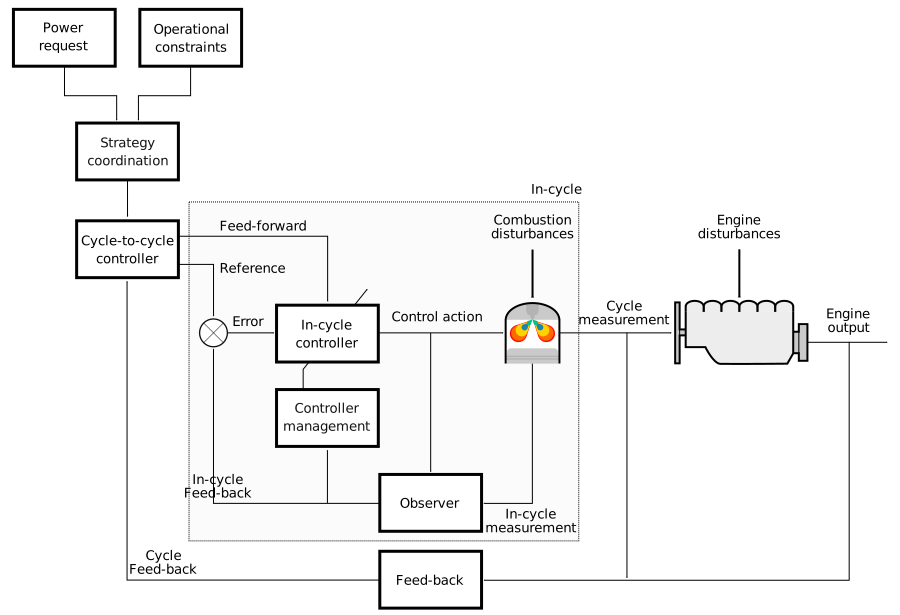
The control system had to behave not only as a feedback controller, but as a real-time decision system. In practice, the cycle-resolved control sequence was:
- Measure in-cylinder pressure.
- Estimate pilot combustion state.
- Predict main combustion response.
- Compute injection correction.
- Apply the correction before the cycle is over.
Why predictive control is needed in-cycle
Combustion control has an intrinsic timing problem. The controller action, such as a fuel injection command, occurs before the measured combustion output is fully available. In a conventional feedback loop, this creates a delay: the controller observes the error after the cycle and compensates in the next one.
For in-cycle control, that delay must be overcome. The controller cannot wait until the full pressure trace or complete heat-release event is available. It must predict how the rest of the cycle will evolve from the partial information already observed.
This is why predictive control is central to in-cycle combustion regulation. The controller needs a model that can estimate the relationship between the current combustion state, the remaining injection command, and the final combustion output.
In the thesis, predictive models were used to overcome the delay between actuator input and measured output. The controller used early pressure-derived information to estimate the state of combustion, predict the effect of candidate fuel-injection actions, and select an injection correction before the available control window closed.
The pilot-main control problem
The research focused on pilot-main diesel combustion. In this combustion strategy, a small pilot injection is delivered before the main injection. The pilot event influences the following main event by changing ignition conditions, heat-release shape, combustion phasing, noise, efficiency, and emissions.
That coupling creates both an opportunity and a challenge.
The opportunity is that the pilot combustion contains early information about how the cycle is developing. If the pilot event is stronger, weaker, delayed, or missing, the controller can detect this before the main injection. The main injection can then be adjusted to compensate.
The challenge is that the available time is short. The controller must estimate pilot combustion, predict its effect on main combustion, compute an actuator correction, and execute the command within a few crank-angle degrees.
The thesis treated this as an in-cycle feedback-control problem. The key controlled variables included combustion phasing, start of combustion, burnt pilot mass, and indicated mean effective pressure. The main control input was the injected fuel amount, commanded through a common-rail solenoid injector.
From virtual sensing to predictive control
Predictive in-cycle control depends on estimation. The controller cannot directly use hidden combustion states unless they are reconstructed from measurements.
The thesis therefore developed a set of virtual sensors and diagnostic estimators based primarily on in-cylinder pressure. These estimators provided information about cylinder volume deviation, heat capacity ratio, start of combustion, pilot misfire, and pilot fuel mass. A related article explains the diagnostic side in more detail: virtual sensing for in-cycle combustion diagnostics.
For predictive control, the pilot fuel mass estimate was especially important. The thesis showed that pilot burnt mass significantly affects the timing and heat-release shape of the main combustion. If the pilot mass could be estimated before the main start of injection, the main injection could be modified to compensate for pilot-combustion variation.
This turned the controller into a sequence of tightly connected operations: measure pressure, estimate early combustion states, predict the remaining response, compute the required correction, and apply the correction before the cycle is over.
Predictive models for combustion regulation
The thesis used model-based prediction to link combustion-state estimates with the expected outcome of the current cycle. The models were developed from experimental characterization of combustion dynamics, using heat-release analysis and measured responses to fuel-injection changes.
The key modeling task was to predict how main combustion would respond to variations in pilot combustion and to changes in the main injection command. This included the interaction between pilot combustion and main combustion, especially the effect of pilot heat release on main start of combustion and main heat-release shape.
The predictive control strategy used this model information to calculate the injection correction needed to reduce cycle-to-cycle variation. Rather than waiting for the final error, the controller anticipated the effect of pilot-combustion variation and acted before the main combustion event was complete.
This is the essence of predictive in-cycle control: use the information available now to estimate what will happen next, then act while there is still control authority.
Online model adaptation
Combustion models are never perfect. They change with operating condition, fuel properties, temperature, EGR level, injection hardware behavior, and cylinder-to-cylinder differences. A predictive controller that depends on a fixed model can lose accuracy when these conditions change.
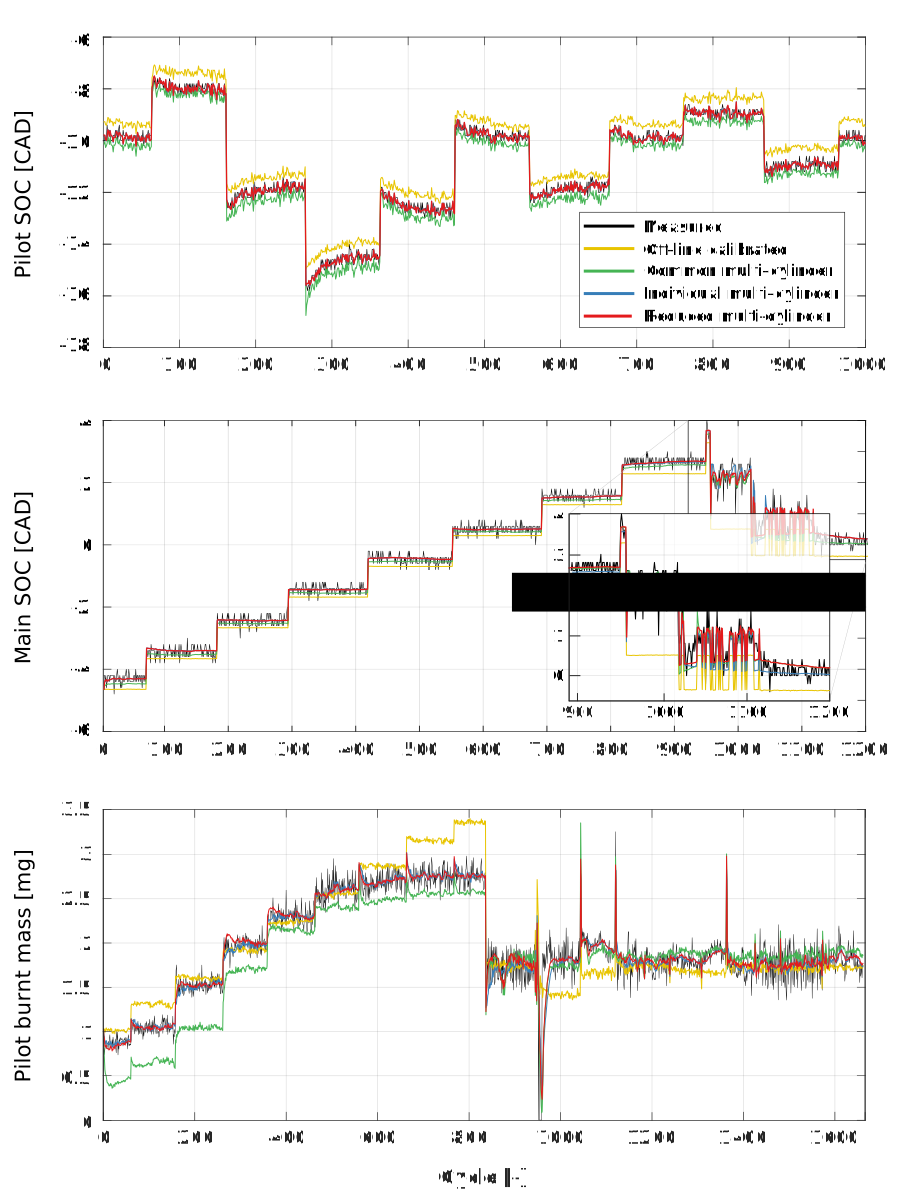
The thesis therefore investigated online model adaptation. The controller updated model parameters during operation to improve prediction accuracy and maintain robustness under changing conditions.
This adaptation was necessary because the same injection correction does not always produce the same combustion response. Fuel properties, for example, affect ignition delay and combustion rate. Operating-condition changes alter the pressure and temperature environment in which the fuel burns. Without adaptation, the controller may calculate corrections based on outdated response behavior.
The research also showed that adaptation must be designed carefully. If too many model parameters are adapted independently, the system can become difficult to calibrate and may introduce undesirable transients. A reduced multi-cylinder adaptation method was therefore proposed to reduce complexity: some parameters were adapted per cylinder, while others were shared across cylinders.
This approach improved robustness while keeping the implementation feasible for real-time control.
Controllability and observability limits
In-cycle control is only possible when two conditions are satisfied.
First, the relevant combustion event must be observable early enough. The controller must detect or estimate pilot combustion before the main injection command must be finalized. If the pilot combustion is too weak, too noisy, or too delayed, reliable diagnosis may not be possible within the available window.
Second, the actuator must still have control authority. The main injection must still be adjustable at the moment when the controller computes the correction. If the main injection has already started, or if hardware timing limits prevent a new command, in-cycle compensation is no longer available.
The thesis explicitly analyzed these observability and controllability restrictions. This is important because in-cycle control should not be treated as always available. There are operating points, injection timings, and combustion conditions where the controller cannot safely or effectively intervene within the same cycle.
The research showed that applying in-cycle control without respecting these limits can reduce efficiency or increase constraint violations. A robust controller therefore needs diagnostic logic that knows when in-cycle compensation is possible and when the system should fall back to other control strategies.
Reducing cycle-to-cycle variation
One of the main outcomes of the predictive in-cycle controller was the reduction of stochastic cyclic variation.
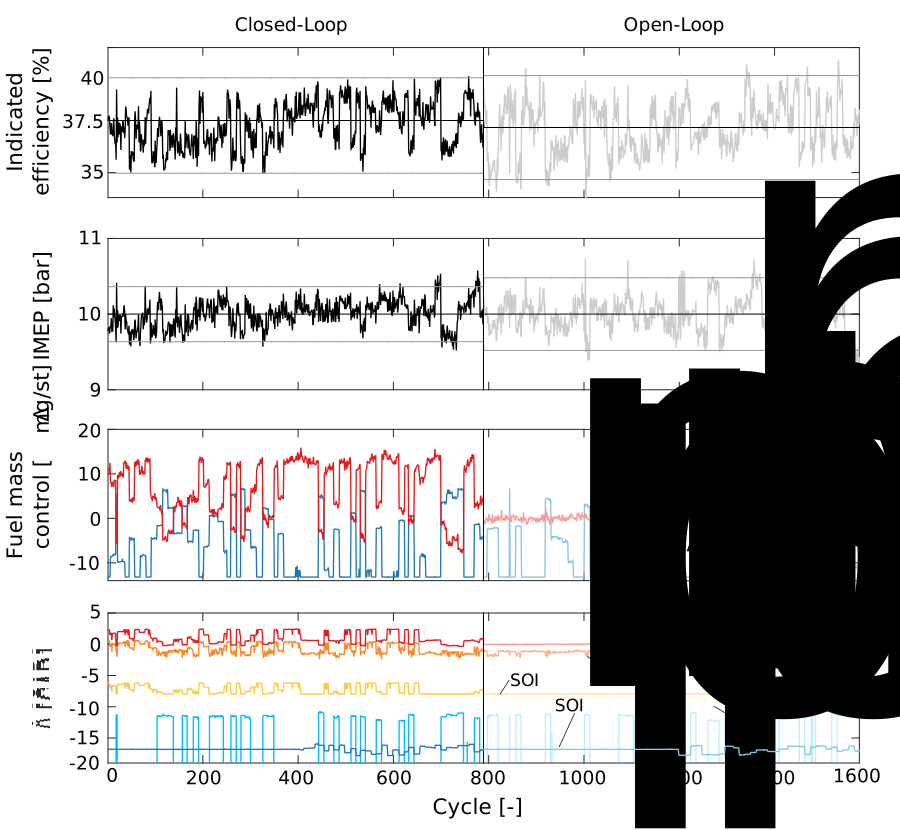
In open-loop operation, variations in pilot combustion can propagate into the main combustion and produce dispersion in combustion phasing and load. With predictive in-cycle control, the system could use early pilot-combustion information to compensate these variations before the main combustion developed.
The thesis reported that predictive in-cycle control reduced pilot start-of-combustion variation from about +/-1 crank-angle degree in open-loop operation to about +/-0.4 crank-angle degrees. Burnt pilot mass variation was reduced from about +/-1.5 mg to about +/-0.6 mg. Main start-of-combustion variation was reduced from about +/-0.4 to +/-0.3 crank-angle degrees, and IMEP variation was reduced from about +/-0.8 bar to +/-0.2 bar.
These results show the value of acting within the cycle. The controller did not merely correct the next combustion event. It reduced the propagation of pilot-combustion variation into the main combustion event of the same cycle.
Robustness under model uncertainty and fuel changes
A predictive controller must remain useful when the model is imperfect. The thesis therefore evaluated controller robustness under model uncertainty and changing fuel conditions.
Fuel changes are a strong test case because they affect ignition delay, combustion rate, and pilot-main interaction. A controller calibrated for one fuel may not predict the same combustion response when another fuel is used. The research included both conventional diesel and high-cetane biodiesel fuels, and the controller was evaluated across operating conditions to assess whether its performance remained robust.
The thesis showed that online adaptation and modular control architecture improved robustness. The controller could maintain improved tracking performance and shorter transients across changing operating conditions and fuel conditions.
This result is important because combustion control cannot rely on a perfectly calibrated model at one fixed operating point. A practical controller must tolerate uncertainty, adapt to changed combustion behavior, and avoid instability when the model is temporarily wrong.
Pilot misfire compensation
Pilot misfire is one of the clearest examples of why in-cycle predictive control is valuable.
If the pilot event fails to ignite, the main combustion can be delayed and the engine load can deviate from its target. In a conventional controller, this would be corrected only after the fault has affected the cycle. In an in-cycle controller, the misfire can be detected before the main combustion develops, and the remaining injection strategy can be changed.
The thesis developed online pilot misfire diagnosis and used it as feedback for compensation. The related diagnostic decision problem is discussed in stochastic fault detection and diagnostic decision logic. When pilot misfire was detected, the controller could use a second pilot injection to recover the combustion trajectory.
With this strategy, the main start-of-combustion error was reduced from +1.5 +/- 0.6 crank-angle degrees to 0 +/- 0.4 crank-angle degrees. The load error was reduced from -0.5 +/- 0.4 bar IMEP to 0 +/- 0.2 bar IMEP.
This result highlights the difference between monitoring and control. Detecting a misfire is useful. Detecting it early enough to compensate for it within the same combustion cycle is much more powerful.
FPGA implementation
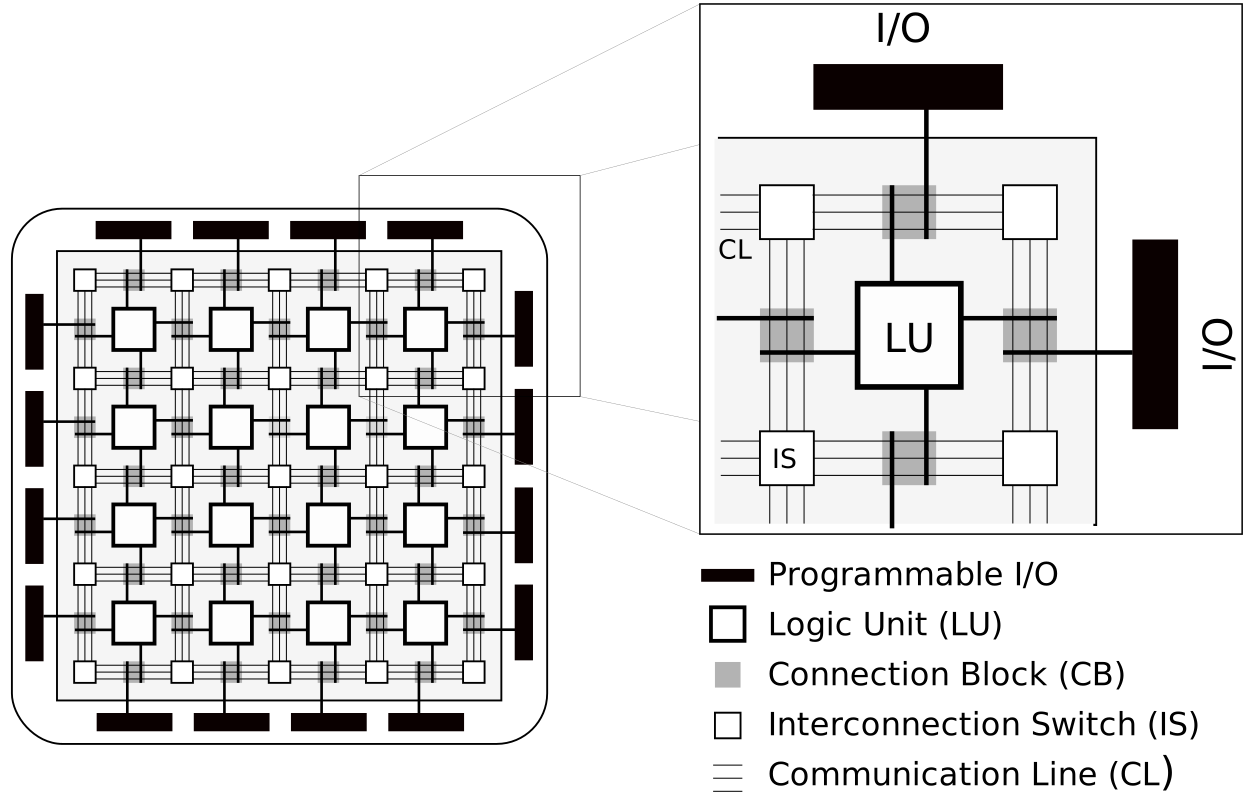
The control algorithms were implemented on FPGA hardware. This was not just an implementation detail; it shaped the control design.
In-cycle combustion control requires computation at crank-angle-resolved time scales. The system must acquire pressure data, process signals, estimate combustion states, update predictions, select controller actions, and synchronize injection commands with engine position. These operations must occur with deterministic timing.
The thesis used FPGA implementation because it allowed fast, parallel, and deterministic computation. At the same time, FPGA hardware introduced resource constraints. The models and estimators had to be simplified enough to fit within available hardware resources while still being accurate enough for control.
This required careful design choices: simplified combustion models, reusable computation blocks, fixed-point representation, modular controller structure, and explicit quantification of hardware requirements.
The result was a practical control architecture rather than only a simulation concept. The controller was designed with real-time execution in mind from the beginning.
Modular controller architecture
The thesis proposed a modular controller design coordinated by a finite-state machine. This structure synchronized measurements, model-based predictions, active controller selection, actuator output, and strategy coordination.
The modular architecture made the system easier to calibrate and extend. Individual controller modules could be developed, tested, and integrated sequentially. The supervisory logic could determine which control mode was active depending on observability, controllability, diagnostic state, and operating condition.
This is particularly important for in-cycle control because the controller may need to switch behavior quickly. For example, normal predictive control may be used when pilot combustion is observable and the main injection remains adjustable. Misfire-compensation logic may be activated when a pilot misfire is detected. A fallback mode may be required when the cycle is no longer controllable.
The finite-state-machine structure allowed these modes to be coordinated in real time.
| Element | Role in control | Implementation concern |
|---|---|---|
| Virtual sensing | Estimates hidden combustion states | Must be early and robust |
| Predictive model | Forecasts remaining cycle response | Must tolerate uncertainty |
| Online adaptation | Updates model behavior during operation | Must avoid over-parameterization |
| FPGA implementation | Enables deterministic real-time execution | Must fit resource constraints |
| Supervisory logic | Selects active control mode | Must respect observability and controllability |
Efficiency benefits
Predictive in-cycle control also supported efficiency optimization.
By reducing cyclic dispersion, the controller allowed the engine to operate closer to efficiency-optimal combustion phasing while still respecting constraints such as maximum cylinder pressure, pressure-rise rate, exhaust temperature, and noise-related limits.
The thesis investigated both direct and indirect efficiency optimization methods. A direct in-cycle optimization method increased indicated efficiency by +0.42 percentage points experimentally. An indirect stochastic optimization method, using the reduced dispersion enabled by in-cycle control, increased indicated efficiency by +0.6 percentage points at medium loads and up to +1.8 percentage points at low loads.
The mechanism is important. The efficiency improvement did not come only from changing the nominal set-point. It came from improving control precision, reducing variability, and making it possible to operate closer to the best feasible point without violating constraints.
What this work shows
The central lesson is that predictive in-cycle combustion control turns combustion regulation into a real-time estimation, prediction, and actuation problem.
The controller must observe combustion while it is still developing. It must estimate hidden states from pressure data. It must predict how the rest of the cycle will respond. It must adapt the model when operating conditions or fuel properties change. And it must execute the correction within strict timing and hardware constraints.
The thesis developed predictive closed-loop controllers that used this structure to regulate combustion within the same engine cycle. The controllers reduced cycle-to-cycle variation, compensated pilot-combustion disturbances, improved transient tracking, maintained robustness under changing fuel and operating conditions, and supported efficiency optimization.
The takeaway
Predictive in-cycle combustion control is about acting before the combustion error becomes final.
In pilot-main diesel combustion, the pilot event contains early information about the current cycle. If that information is converted into a reliable state estimate, and if a predictive model can estimate the effect on main combustion, the controller can modify the remaining injection strategy before the cycle is over.
That is the contribution of this part of the thesis: it showed how predictive models, virtual sensing, online adaptation, and real-time FPGA implementation can work together to make same-cycle combustion regulation possible.
In practical terms, the work moves combustion control from delayed correction toward real-time intervention. The engine does not only learn from the previous cycle. It observes the current one, predicts where it is going, and changes course while there is still time.
Source articles
This article is based on my PhD thesis and the following thesis papers:
- Carlos Jorques Moreno, Ola Stenlaas, and Per Tunestal, “Predictive In-Cycle Closed-Loop Combustion Control with Pilot-Main Injections,” IFAC-PapersOnLine, 53(2):14000-14007, 2020.
- Carlos Jorques Moreno, Ola Stenlaas, and Per Tunestal, “Multi-Cylinder Adaptation of In-Cycle Predictive Combustion Models,” SAE Technical Paper 2020-01-2087, 2020.
- Carlos Jorques Moreno, Ola Stenlaas, and Per Tunestal, “In-Cycle Closed-Loop Combustion Control for Pilot Misfire Compensation,” SAE International Journal of Advances and Current Practices in Mobility, 3(1):299-311, 2021.
- Carlos Jorques Moreno, Ola Stenlaas, and Per Tunestal, Design and Optimization of In-Cycle Closed-Loop Combustion Control with Multiple Injections, PhD thesis, Lund University, 2021.
Need help designing real-time combustion control or model-based diagnostics?
I work on predictive combustion control, virtual sensing, embedded decision logic, model adaptation, and FPGA-oriented control implementation for advanced powertrain systems.